Article summary
Why rust-free aluminium fencing is a smart choice for Auckland's coastal and seaside properties.
- Category:
- materials
- Read time:
- 8 min
- Published:
- 26 December 2025
- Written by:
- My Homes Fencing Expert
Quick answer: aluminium is the standout fence for coastal Auckland homes because it simply doesn't rust in salt air — unlike steel, which corrodes, or timber, which weathers fast near the sea. Add near-zero maintenance, a durable powder-coat finish, pool-fence compliance, a clean modern look, light weight and a long lifespan, and it's easy to see why it's the go-to by the coast. It costs more upfront than timber, but the durability earns it back.
Salt air is brutal on the wrong fence. Here's why aluminium keeps winning on coastal and seaside sections around Auckland.

1. It Doesn't Rust — The Benefit Everything Else Rests On
Steel rusts because iron oxide flakes away, exposing fresh metal underneath, so corrosion feeds on itself. Aluminium behaves in the opposite way: it forms a thin, hard oxide layer that seals the surface and stops the process. That is not marketing language, it is basic metallurgy, and on a boundary that catches salt off the Hauraki Gulf or the west coast it is the difference between a fence that ages and a fence that fails.
Coastal Auckland punishes the wrong choice quickly. Salt-laden air settles on every surface, and anywhere it can find bare steel — a cut edge, a drilled hole, a scratched rail, a cheap screw — it starts working. Owners near the water usually recognise the pattern: rust bleed running down an otherwise sound fence from a handful of fixings.
Aluminium removes that failure mode entirely. Everything else on this list is a genuine benefit, but this is the one that decides the material for most seaside properties.
2. Maintenance Is a Hose, Not a Schedule
A timber fence near the coast has a maintenance calendar. Wash it, let it dry, re-coat it, repeat. Miss a couple of cycles and the fence starts aging faster than the calendar can catch up. That is a manageable commitment on a sheltered inland boundary and a genuinely demanding one within reach of salt spray.
Aluminium has no coating cycle at all. The recommended routine is to rinse salt and grime off periodically, which for most owners means aiming a hose along the fence when they wash the car. Salt that sits on any surface for months is abrasive and unsightly, so rinsing is worth doing, but nothing about it is urgent and nothing about it degrades if you skip a month.
This matters most on the runs you cannot easily reach — a boundary above a bank, behind established planting, or on the seaward side where you would need to be on someone else's land to work on the far face.
3. The Finish Is Baked On, Not Brushed On
Powder coating is applied as a dry powder, electrostatically charged so it clings evenly to the metal, then cured with heat until it fuses into a continuous hard film. It behaves nothing like a painted finish. There is no brush-mark thinning at edges, no solvent evaporating out over years, and no annual repaint hanging over you.
Quality varies, and it is worth asking about. Coating systems intended for marine and coastal exposure use different pre-treatment and resin chemistry from standard architectural coatings, and the pre-treatment — how the aluminium is cleaned and prepared before coating — matters as much as the powder itself. A cheap system on a seafront boundary can chalk and fade years earlier than a marine-grade one.
Deep scratches that reach bare metal are worth touching up for appearance, but they do not set off the chain reaction they would on steel. The exposed aluminium simply forms its own oxide layer and stops.
4. It Suits Pool Barriers Without Compromise
Residential pool barriers in New Zealand have to meet real requirements — minimum height, restricted gaps, a non-climbable zone free of footholds, and gates that are self-closing and self-latching with the latch out of a small child's reach. Councils inspect pool barriers periodically, and a barrier that has degraded is a compliance problem, not just a maintenance one.
Aluminium fits that brief unusually well. Vertical slats at compliant spacing give no horizontal footholds to climb, the material shrugs off constant splash, chlorine and sunscreen residue, and the gate hardware stays working because the frame it is mounted to does not swell, shrink, warp or rust.
The material never makes a barrier compliant on its own — height, gaps, the non-climbable zone and the gate hardware all have to be right, and that is a design and installation question. But aluminium removes the slow degradation that turns a compliant barrier into a non-compliant one over a decade.
5. Open Styles Keep the View You Paid For
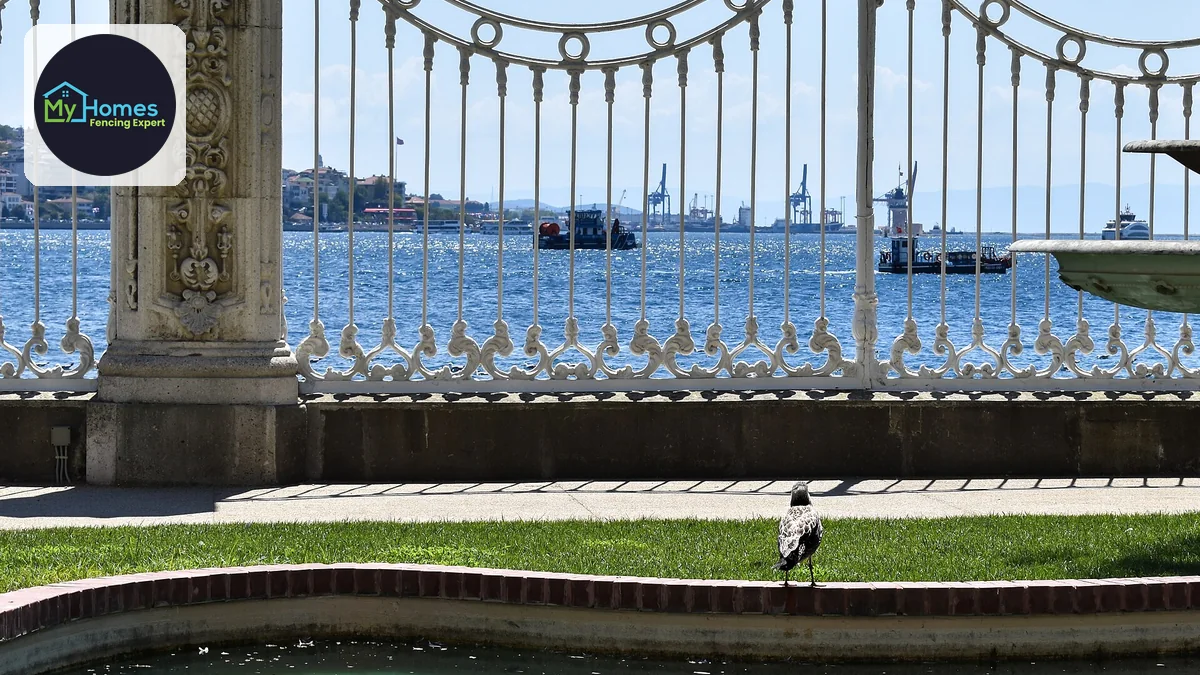
Many coastal Auckland properties are bought for an outlook, and then fenced in a way that partly cancels it. A solid fence at a seaward boundary delivers privacy and wind shelter but takes the water view with it — a genuinely expensive trade on a site where the view is the point.
Aluminium is the material most comfortable in the middle. Vertical slat spacing can be tuned to filter sightlines without blocking them, louvre systems angle blades to screen the street while keeping the view from the house, and glass-and-aluminium combinations preserve the outlook entirely where wind shelter is not required.
The practical approach on most seaside sections is not to pick one style for the whole property but to vary it by boundary: solid or close-board where you need privacy and shelter, open slat or louvre where the view matters.
6. Light Weight Makes Awkward Coastal Sites Easier
Coastal sections are rarely flat, level and easy to reach. Cliff-top boundaries, sites accessed down steps, narrow rights-of-way and banks that a truck cannot get near are common. Anything you install has to be carried in, and weight becomes a real cost driver.
Aluminium's strength-to-weight ratio matters here in an unglamorous, practical way. Panels are manageable by hand where equivalent steel or a heavy solid alternative would need machinery or a much larger crew. That does not make aluminium cheap, but it removes access premiums that can dominate a quote on a difficult site.
Lower weight also means less load on the posts and footings, which is worth something on soft ground, fill, or the marginal soils common near the water.
7. A Lifespan That Repays the Premium
Aluminium costs more upfront than timber. That is straightforward and it is the main reason people hesitate. The case for spending it is that the two most common reasons a coastal fence gets replaced early — rot and corrosion — do not apply, so the fence tends to be replaced because tastes changed rather than because it failed.
The honest caveat is that this only holds if the specification is right. A budget aluminium system with a thin coating and mismatched fixings on a seafront boundary will disappoint. The system quality, the coating grade and the fixings are what convert aluminium's theoretical durability into an actual long-lived fence.
Judged over the full life of a coastal boundary, aluminium frequently ends up the cheaper fence. Judged on the first invoice, it never does. Which comparison is fair depends on how long you plan to be there.
Getting Aluminium Right on a Coastal Boundary
If you take three things from this list: ask what the coating system is rated for, confirm the fixings are compatible with aluminium in a marine environment, and vary the style by boundary rather than fencing the whole section the same way.
Aluminium is not automatically the right answer everywhere on a coastal property. Sheltered rear boundaries well back from the water often do perfectly well in timber at a lower cost, and spending the aluminium budget where the salt actually lands is a better use of it.
My Homes Fencing Expert installs aluminium fencing across Auckland's coastal suburbs and will tell you honestly which of your boundaries need it and which do not. Call 022 315 8987 or book a free, no-obligation site quote.
Frequently Asked Questions
Because it does not rust. Aluminium forms a stable oxide layer that seals the surface, where steel's rust flakes away and exposes fresh metal, so corrosion keeps going. Add a baked-on powder-coat finish, no re-coating cycle and a long life, and it is the standout for salt-air boundaries.
Correct — rust is specific to iron and steel. Aluminium does corrode in a limited surface way, but the oxide layer it forms is hard and self-sealing, so the process stops instead of spreading. That is why scratches on aluminium stay cosmetic while scratches on coated steel do not.
Usually, if you are staying put. Rot and corrosion are what end most coastal fences early, and aluminium removes both, so it tends to be replaced by choice rather than by failure. On the first invoice it is always more expensive than timber.
Three things: what the powder-coat system is rated for in a marine environment, how the aluminium is pre-treated before coating, and whether the fixings are compatible with aluminium near salt. Mismatched fixings are the most common way a good aluminium fence ends up with rust bleed down it.
Yes, and it is the most common choice. It handles splash, chlorine and sunscreen residue, and vertical slats give no footholds in the non-climbable zone. The barrier still has to meet the height, gap, non-climbable-zone and self-closing, self-latching gate requirements — material alone does not make it compliant.
Only if you choose a solid style. Slat spacing can be tuned to filter sightlines, louvres screen the street while keeping the view from the house, and glass-and-aluminium keeps the outlook entirely. Most coastal sections are best fenced boundary by boundary rather than uniformly.
Ready to start your fencing project?
Get a free, no-obligation quote anywhere in Auckland.
Get a Free QuoteRelated fencing services