Article summary
Creative privacy fencing ideas that keep prying eyes out while keeping your outdoor space feeling open and bright.
- Category:
- design
- Read time:
- 8 min
- Published:
- 22 January 2026
- Written by:
- My Homes Fencing Expert
Quick answer: full solid privacy doesn't have to mean a flat, boxed-in yard. Mixing solid lower panels with slatted or louvred upper sections, stepping the height up only where you're overlooked, or pairing a lower fence with planting all give privacy without the tunnel effect a single tall, solid wall can create.
Privacy is one of the most common reasons Auckland homeowners fence at all — new-build sections are getting tighter, and two-storey neighbours can suddenly overlook a deck or pool that used to feel private. The good news is there's more than one way to solve it.
Find Out What You're Actually Blocking
Almost everyone approaches privacy as a height problem — the fence is too low, so build it higher. That instinct leads to a lot of unnecessarily tall, unnecessarily expensive fences that make small sections feel like courtyards, and it often does not even solve the problem.
Privacy is geometry, not height. What you are trying to do is interrupt a line between a specific viewpoint — their upstairs window, their deck, the footpath at a particular point — and a specific place you want to be private. That line has an angle, and where you interrupt it matters enormously.
Do the practical version of this before you spend anything. Stand in the spot you want private, look back at what overlooks it, and have someone hold a broom or a length of timber at various heights along the boundary until the view is blocked. You will frequently find that a modest amount of extra height in one four-metre stretch does what you assumed needed a taller fence around the whole section.
Interrupt Close to the Viewer or Close to You
This is the part that saves the most money. Blocking a sightline is far more efficient the closer you get to either end of it — because a screen near you, or near them, subtends a much larger angle than the same screen halfway between.
In practice that means a screen right beside your seating area can be much lower than a boundary fence doing the same job from ten metres away. A 1.8-metre screen two metres from where you sit blocks more than a 2.2-metre fence at the boundary, and it costs a fraction as much because it is four metres long instead of thirty.
It also means the fence is not always the answer. A pergola with a solid section, a planter with a screen on it, or a repositioned outdoor seating area can each solve an overlooking problem that a boundary fence would need to be non-compliantly tall to address.
Solid, Slat or Louvre
Solid close-boarded timber or PVC gives complete privacy and is the right answer where you are directly overlooked at close range. It is also the cheapest way to buy full privacy per metre. The costs are shade, wind load, and the boxed-in feeling on a narrow section.
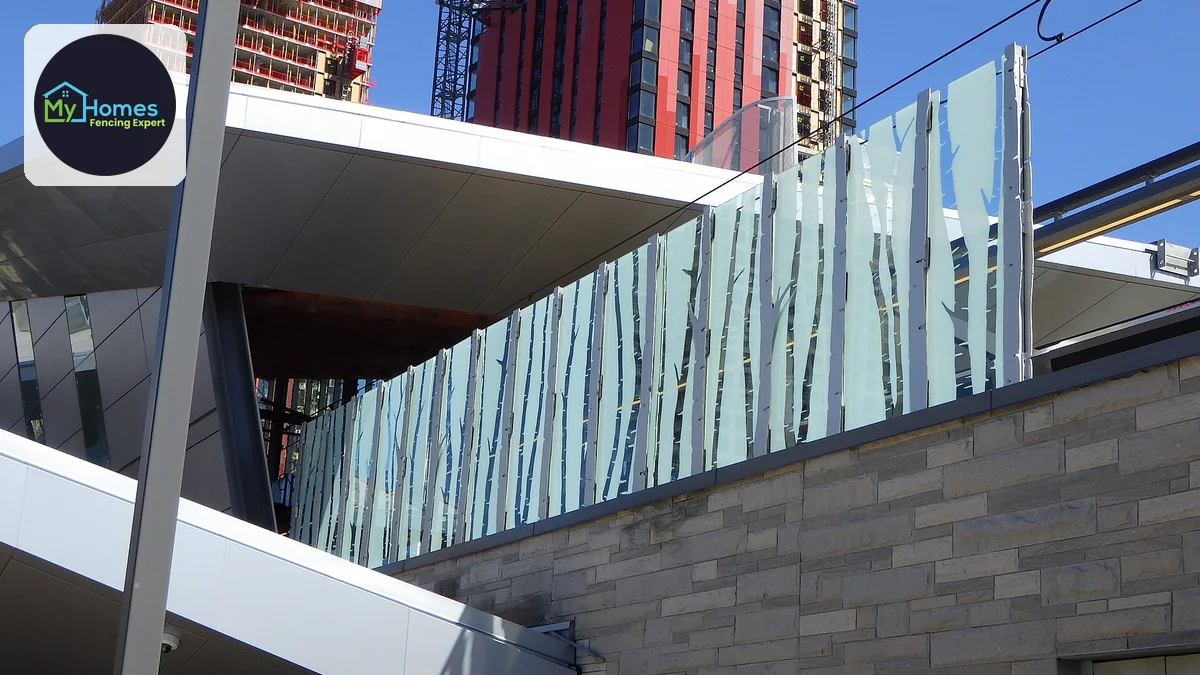
Slat fencing is more private than people assume, because it is far more private from an angle than straight on. As a viewer moves off square, the slats overlap in their line of sight and the fence reads as solid — and neighbours and passers-by almost always see your boundary at an angle rather than square-on from the middle of your lawn.
Louvre is the specialist tool and the one most under-used. Angled blades block the view from above and to one side while leaving the view from your own eye level and the airflow intact. That makes louvre the right answer specifically for the two-storey-neighbour problem, where you are being looked down into rather than across at.
Step the Height Only Where You Need It
Very few properties need maximum privacy along the whole boundary. The efficient pattern is a standard-height fence for most of the run, stepping up to a taller screened section only where the overlooking actually happens — the spa corner, the outdoor dining area, a bedroom window sightline.
Done casually this looks like an afterthought. Done deliberately it looks designed: keep the step in one clean transition rather than several, align it with something in the landscape like a corner, a planting bed edge or a path, and carry the same material and colour through so it reads as one fence with a considered change in it.
The other advantage is compliance. Height limits apply along the whole boundary, and a fence that only exceeds a standard height in one short section is a far smaller conversation with Council — and with your neighbour — than one that towers along the entire run.
Height Rules Will Constrain You
In most Auckland residential zones a fence up to two metres is generally a permitted activity, with anything taller typically requiring resource consent. That is the ceiling most privacy projects run into, because two metres does not always solve a two-storey overlooking problem.
Front yards are usually more restricted again, often with a lower limit for a solid fence and more allowance for a partly open one. This trips up people trying to gain privacy from the street, where the rules are deliberately tighter to stop streets becoming walled corridors.
Zones, overlays and specific site conditions all change the answer, so check your address with Auckland Council rather than working from a general figure. And remember that a trellis topper counts toward the height — adding lattice to an existing 1.8-metre fence is exactly how people accidentally exceed the limit.
Freestanding Screens Sidestep the Problem
A screen that is not on the boundary is not a boundary fence, and that changes several things at once. There is no neighbour to agree with, no cost-sharing conversation, no boundary line to establish, and generally a different — often more forgiving — set of rules than the boundary fence height limits.
More importantly, a freestanding screen can be positioned where it does the most work. Following the geometry above, a screen placed close to the area you want private is far more effective per metre than the same screen at the boundary, so you buy less of it.
This is the answer we most often recommend for a single problematic sightline — a neighbour's new upstairs window, a deck that got built next door, a driveway that looks straight into a living area. One well-placed panel solves it. A whole boundary rebuild would have been a much larger way to solve the same problem.
Light, Shade and Which Boundary You're Fencing
Before committing to solid fencing at height, work out which boundary it is on, because the shade consequences are wildly different. In New Zealand the sun sits to the north, so a tall solid fence on your southern boundary casts its shadow onto your neighbour, not you.
A tall solid fence on your northern boundary does the opposite — it shades your own yard through the middle of the day, and on a narrow section that can take a sunny outdoor area and make it permanently cold. This is the single most common privacy regret we hear, and it is entirely predictable in advance.
Where the northern boundary is the problem one, slat and louvre earn their price. They break the sightline while letting a meaningful amount of light through, which a solid panel simply cannot do. Pairing a mid-height fence with planting or a trellis topper is the other route — slower, because planting takes a season or two to fill in, but softer and better for light. My Homes Fencing Expert will walk the sightlines with you before quoting. Call 022 315 8987 or book a free, no-obligation consult.
Frequently Asked Questions
Slat fencing is more private than people expect, because it reads as solid from an angle — which is how neighbours and passers-by actually see your boundary. Louvre goes further for the two-storey problem, blocking the downward view while keeping your own outlook and airflow.
Usually not. Privacy is geometry rather than height — you're interrupting a line between a specific window or deck and a specific spot in your yard. Stand in that spot, have someone hold a length of timber along the boundary, and you'll often find one short section does the job.
Near your seating area, almost always. A screen close to you blocks a much wider angle than the same screen ten metres away, so it can be lower and far shorter. A 1.8m screen two metres from where you sit can outperform a 2.2m fence at the boundary, for a fraction of the cost.
In most residential zones a fence up to 2m is generally permitted, with taller usually needing resource consent, and front yards are typically more restricted. Check your specific address and zone with Auckland Council — and note a trellis topper counts toward the height.
Often yes — a trellis topper or lattice extension adds height and screening without a rebuild, provided the existing posts are sound enough for the extra wind load. Check the posts first by pushing on the fence and watching whether the base pivots at ground level.
It depends entirely which boundary. The sun sits to the north here, so a tall solid fence on your southern boundary shades your neighbour, while the same fence on your northern boundary shades your own yard through the middle of the day. That's the most common privacy regret we hear.
A fence for immediate, reliable privacy; a hedge for softness, habitat and a better light outcome — but it takes seasons to screen anything and needs trimming forever. The common compromise is a mid-height fence with planting in front, which gives privacy now and greenery later.
Ready to start your fencing project?
Get a free, no-obligation quote anywhere in Auckland.
Get a Free QuoteRelated fencing services