Article summary
PVC fence styles and colours: pickets, privacy panels, lattice tops and semi-private designs — plus how to choose a colour you'll keep.
- Category:
- materials
- Read time:
- 7 min
- Published:
- 24 July 2026
- Updated:
- 2 November 2026
- Written by:
- Md Mahfuzur Rahman (Milton), Project Manager, My Homes Fencing Expert
PVC fencing gets summarised as 'the white picket one', which undersells a range that now runs from cottage frontages to full-height privacy walls. The PVC fence styles on the New Zealand market cover most residential briefs — what they share is the factory finish that never needs a brush, which also makes choosing the style and colour a more permanent decision than it is with timber.
Here's the working tour of the range: the picket family, privacy and semi-private panels, the lattice-top hybrids, the colour palette and its limits, and the matching question that decides whether a PVC fence looks intentional or ordered from a catalogue.
PVC Fence Styles: The Full Range
In short: PVC fencing comes in four working families — picket fences in several profiles, full-privacy panels, semi-private spaced-board designs, and combination styles topped with lattice or spindles. Heights run from garden-low pickets to full 1.8-metre privacy.
Every style arrives as an engineered system: posts, rails and infill made to fit together, which is why PVC installs crisp and stays that way — and why custom shapes outside the system cost disproportionately.
Style availability varies between suppliers and changes over time, so confirm current ranges when you're ready to specify.
The Picket Family
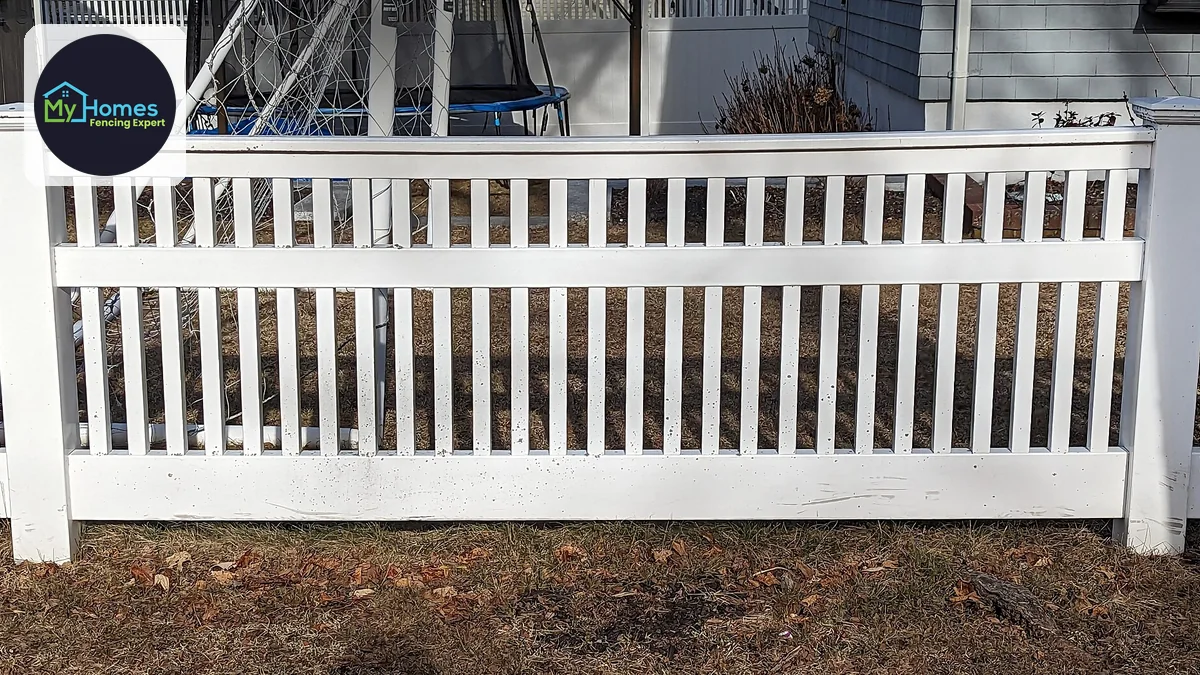
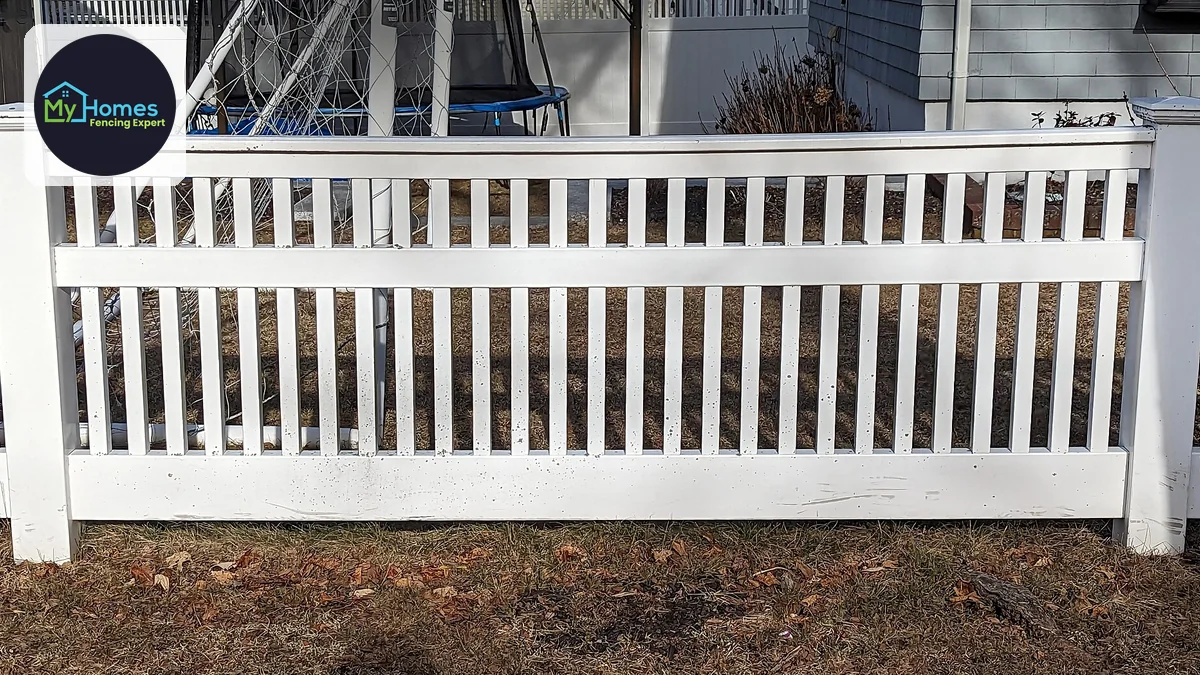
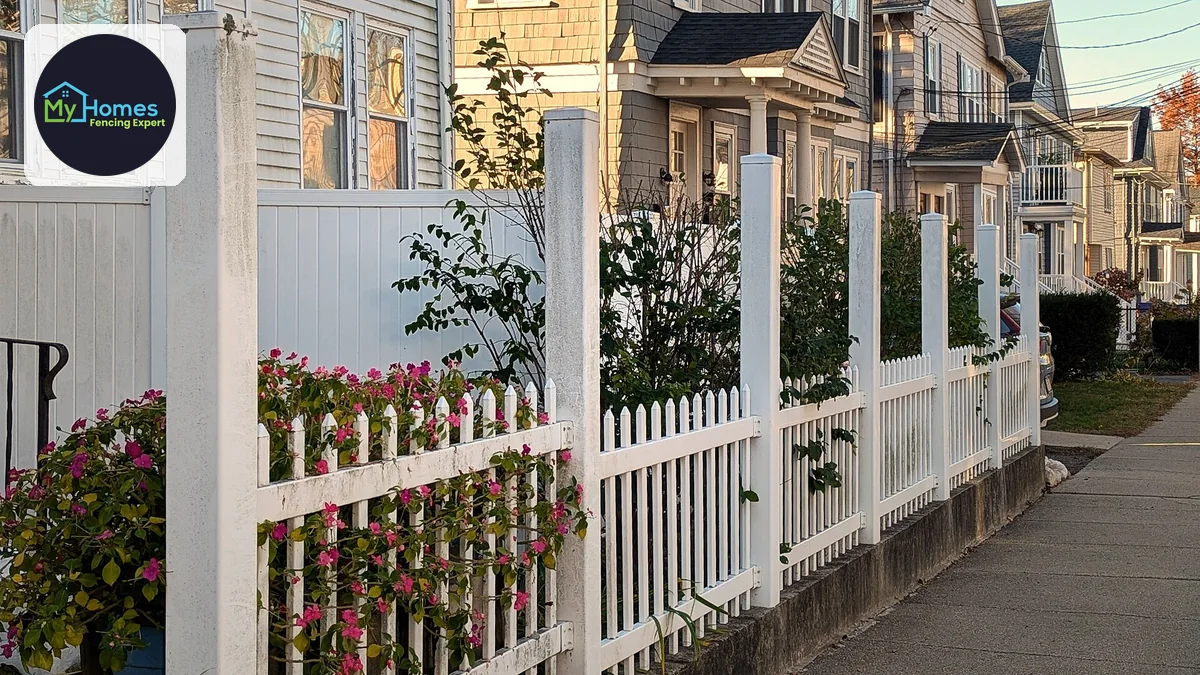
Pickets are PVC's home ground: spaced uprights with shaped tops — pointed, dog-eared, rounded or flat — in heights from knee-high garden borders to chest-high frontages. The crisp white version reads permanently fresh-painted, because effectively it is.
Profile choices change the character more than people expect: wide flat pickets read modern-coastal, narrow pointed ones read classic villa, scalloped runs read cottage. Hold the profiles against your house's era before defaulting.
Gates match every picket system, with the usual reminder that hidden steel reinforcement is what keeps a PVC gate square for years — confirm it's in the quote.
Privacy and Semi-Private Panels
Full-privacy PVC uses interlocking tongue-and-groove boards between posts — a smooth, gap-free face that screens completely, washes clean, and never develops timber's shrinkage slots. It's the style our timber-versus-PVC comparison sends maintenance-averse owners toward.
Semi-private designs space the boards or alternate them shadowbox-style, trading total screening for airflow and a lighter look — the same wind logic that applies to all fencing on exposed Auckland sites.
Lattice-top combinations put privacy below and decorative openness above, softening the wall effect on long runs and suiting pool-adjacent and garden settings.
Colours: The Palette and the Permanence
The PVC palette centres on whites, creams and soft greys, with some ranges adding tans and darker greys, and embossed woodgrain textures on premium lines. It's narrower than a paint chart — by design, since the colour runs through the engineered product.
That permanence is the trade: no repainting ever, and no repainting ever. Choose against your cladding, roof and joinery with samples in real daylight, because this decision doesn't get a second coat.
Practical note: very dark colours in any rigid plastic run hotter in full sun, which is one reason the range stays light-biased. Quality UV-stabilised product holds whichever colour you pick.
Matching Style to House and Street
Villas and cottages take pickets naturally; mid-century and contemporary homes wear flat-profile pickets, clean privacy panels or grey tones better than ornate white. The fence should look like the house chose it.
Think about the streetscape too — a gleaming white run in a street of stained timber stands out, for better or worse. Cream and grey tones blend where white announces.
And keep the system consistent: matching gates, post caps and trims from the same range is what makes the installation read designed rather than assembled.
How Does a PVC Fence Handle Heat and Sun?
PVC moves more than timber as temperatures change, so a good system is designed for it. Rails are usually made to float in the posts instead of being rigidly fixed, and pickets need clearance so they don't bind when they expand. When a PVC fence bows, the usual culprits are fixings that stop that movement or an installation that doesn't follow the system's instructions, so workmanship matters as much as the product.
Style changes how much you'll notice this. A long, solid privacy panel in full sun shows movement more than a short picket run, and the face toward the sun tends to bow first. Asking for shorter bays on a long, exposed run, or for reinforced rails, is reasonable. It's also why you should be cautious about darker colours on a hot, north-facing boundary.
New Zealand's strong UV is the other test. PVC for fencing should be formulated with UV stabilisers, and products without proper stabilisation can discolour or weaken over time. Ask what's in the range being quoted and what the warranty says about colour. Wall thickness and rail reinforcement are worth asking about too, because they're what stop a fence sagging as it ages.
What Do PVC Styles Cost, and What If a Panel Breaks?
As a guide including GST, a PVC fence is $220–$500 per linear metre, so a 20m run budgets at about $4,400–$10,000. Pickets sit toward the lower end because they use less material, and full-privacy panels and lattice-top designs sit higher. Gates are priced separately, and hidden reinforcement is what keeps them square, so check it's included.
PVC isn't usually patched like timber. A cracked board or picket is generally replaced as a component, which makes it important that the same range remains available. Ask how long the range has been sold and how replacement parts are ordered, and consider keeping a spare board or two from the original job.
Colour matching gets harder with age. A new white or grey board can look noticeably cleaner beside panels that have weathered for years, so a good wash of the whole run often helps it blend. Our PVC cleaning guide covers how to do that safely. If you're considering PVC around a pool, make sure the specific product is designed for pool barrier use, since not every style is suitable.
See the Styles Properly Before Choosing
My Homes Fencing Expert supplies and installs PVC fencing across Auckland — pickets to privacy — with current style and colour samples you can judge against your own cladding rather than a brochure.
Call 022 315 8987 or book a free, no-obligation quote online; bring the house's era to the conversation and we'll bring the profiles that suit it.
Frequently Asked Questions
Four working families: pickets in several profiles and heights, full-privacy tongue-and-groove panels, semi-private spaced or shadowbox designs, and lattice-top combinations — all as engineered systems with matching gates and trims.
Mostly whites, creams and greys, with some ranges adding tans, darker greys and woodgrain textures. The palette is narrower than paint because the colour is the product — and it's permanent, so choose with samples in daylight.
It's not designed for it — the factory colour is the finish for the fence's life. That's the appeal (no repainting) and the constraint (no repainting), so treat colour as a one-time decision.
Flat-profile pickets, clean privacy panels and grey tones sit well on contemporary homes; ornate white pickets belong to villa and cottage eras. Match the profile and colour to the house's age and the fence reads intentional.
No — wall thickness, UV stabilisation and rail reinforcement vary between ranges, and they're what separate decades of service from early sagging and fade. Ask what specification is being quoted, not just what style.
PVC expands and contracts with temperature, so systems let rails float in the posts. Bowing usually comes from fixings or installation that stop that movement, and long, solid panels in full sun show it most. Quality product installed to the system's instructions handles this well.
Usually, as an individual board or picket, provided the same range is still available. Ask how replacement parts are ordered before you buy. A new board may look cleaner than aged ones at first, so washing the whole run helps it blend in.
Official Sources
General information, not legal advice. Rules vary by property and zone, so check your address with Auckland Council before you build.
Ready to start your fencing project?
Get a free, no-obligation quote anywhere in Auckland.
Get a Free QuoteRelated fencing services